

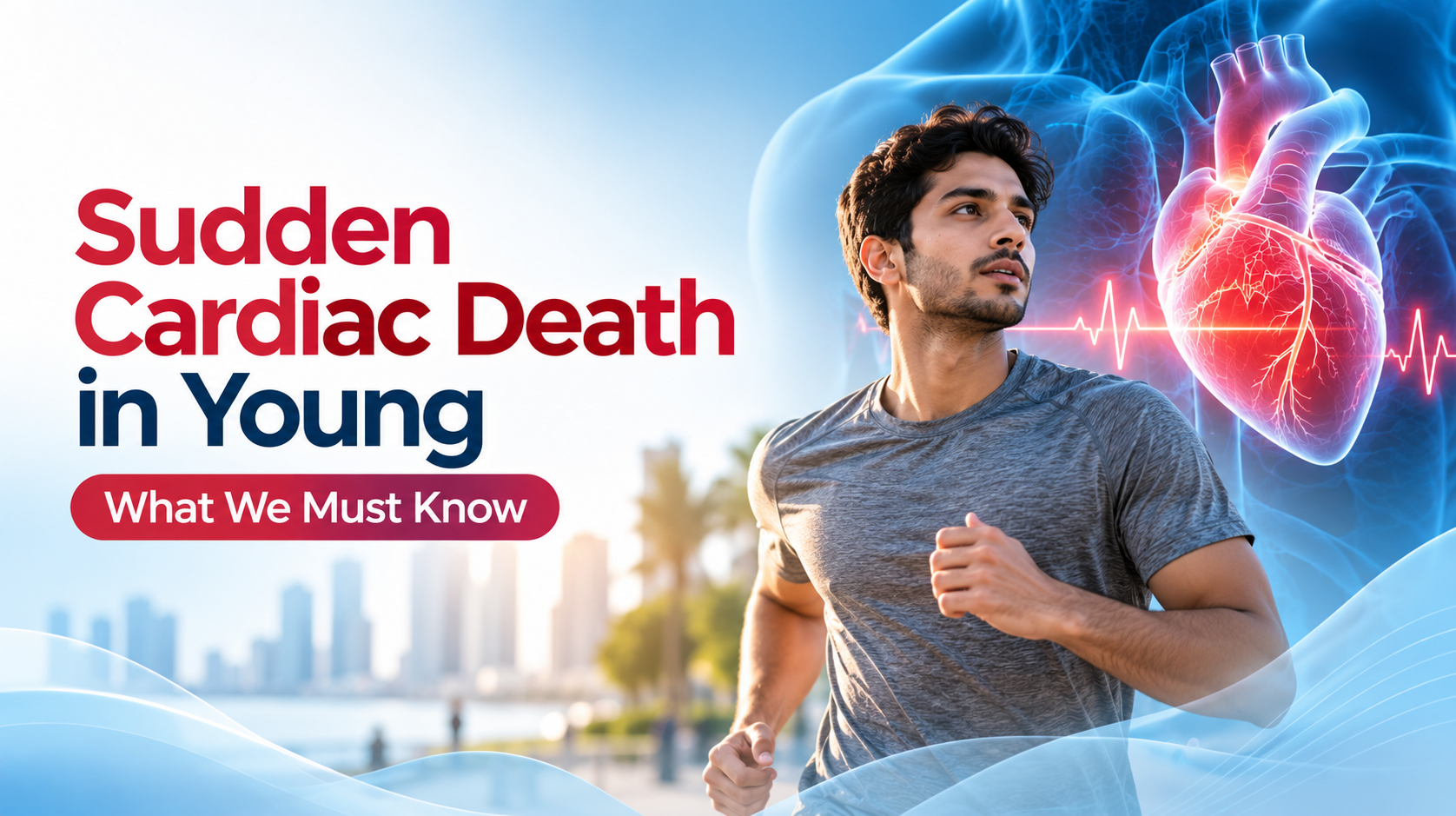
SUDDEN CARDIAC DEATH (SCD) IN YOUNG
What We Must Know
Sudden
cardiac death (SCD) is an unexpected death from cardiac cause occurring in a
short time period (generally within one hour of symptom onset) in a person with
known or unknown cardiac disease. There is a wrong belief among the public that
all SCD is due to myocardial infarction (heart attack). That is not correct — a
lot of other cardiac conditions can result in SCD. At present we don't have any
large-scale studies regarding SCD either from India or Kerala, so we have to
depend on studies from other countries.
This article is based on an important study conducted in Australia on SCD victims. The article is published in the most popular heart journal — Circulation, 2022, Vol. 13, Issue 13 — by the American Heart Association. This study was conducted on 2,006 SCD victims during a 16-year period, from 2000 to 2016. This is a very authenticated study because of the huge number of patients and the long duration of the study. In this study, 95% of victims underwent autopsy to find out the cause of death, and in 97% of victims a toxicological analysis was done to ascertain whether the cause of death was due to poisoning. The victims included were between the ages of 1 year and 35 years.
Causes of Sudden Cardiac Death
Now let us look at the reasons and causes of SCD.
1. Coronary Artery Disease (CAD/ASCVD)
This
results from sudden obstruction of blood flow (coronary thrombosis) in the
arteries supplying blood to the heart (heart attack), or in patients who had a
myocardial infarction developing another acute coronary event (re-infarction),
or a fatal arrhythmia like ventricular tachycardia or ventricular fibrillation.
SCD also results from mechanical complications like cardiac rupture, or massive
pulmonary or cerebral embolism.
This
is an abnormality in the cardiac muscle, where the result is excessive
thickening — hypertrophy — of the heart muscle, resulting in obstruction of
blood flow from the left ventricle to the aorta (sub-aortic obstruction).
Patients with this condition can develop SCD as a result of fatal cardiac
arrhythmias. A strong genetic basis has been documented in this disease
condition.
This is a disease primarily affecting the cardiac muscles. They are of two main types — dilated cardiomyopathy and restrictive cardiomyopathy. The cause of SCD in these conditions is, many a time, due to fatal cardiac arrhythmias.
4. Channelopathies
Ion
channelopathies involve abnormalities of sodium and potassium channel
permeability to these ions. In this condition the heart is structurally normal;
the ECG may show changes sometimes. SCD in these patients results from fatal
ventricular arrhythmias. There are different types of channelopathies,
described below.
The
ECG in this condition will be abnormal, sometimes mimicking myocardial
infarction. There are four types of early repolarisation abnormalities. Here
too the heart is structurally normal, but 10% of patients have underlying
mitral valve prolapse (MVP).
This
has a strong genetic association. Patients with this disease have an abnormal
ECG and are classified into various types depending on the ECG changes. They
also have a structurally normal heart. SCD occurs due to triggers such as loud
sound, a phone ringing, diving into water, or fever.
Patients
with this abnormality have ECG changes and an abnormal echocardiogram.
Diagnosis is usually confirmed by cardiac MRI. They are prone to lethal
ventricular arrhythmia and SCD.
These
occur in a structurally normal heart, with high risk for SCD due to fatal
arrhythmias. There is a strong genetic association, with autosomal dominant and
recessive varieties, where there can be other congenital abnormalities like
congenital deafness. Sometimes drugs can produce QT prolongation and lethal
arrhythmias, called polymorphic ventricular tachycardia.
Typically,
these patients develop SCD during exercise, where the fatal ventricular
arrhythmias are precipitated by exercise resulting in an excess catecholamine
surge. The heart is structurally normal.
This is an abnormality in the origin and course of the coronary arteries — a congenital cardiac anomaly where SCD occurs in certain types of congenital coronary anomaly, where the main coronary artery can be compressed between the aorta and pulmonary artery, especially during exercise (the so-called haemodynamic vise). It is diagnosed by coronary angiography or CCTA.
Incidence of SCD
From
European studies, the incidence of SCD in the young (1–35 years) is estimated
to be 1.3 to 2.9 per 10,000 population. However, in the present Australian
study, it is much lower — reported as low as 0.91 to 1.48 per 100,000
population.
SCD
incidence is found to be more in men than in women, and more in
non-metropolitan than in metropolitan regions. This difference could be due to
the availability of advanced medical facilities, services, and efficient
ambulance service systems.
A very important observation in this study is that 34% of SCD victims were found to have obesity, and in 38% of cases SCD occurred during sleep or resting time. Only 7% of SCD occurred during exercise.
The
commonest cause of SCD is CAD — about 40% of SCD results from acute coronary
syndrome (ACS — acute myocardial infarction or heart attack) or CAD-related
causes.
Sudden Arrhythmia Death Syndrome (SADS): After CAD, the commonest cause of SCD is SADS. 10% of SCD is caused by myocarditis, a disease primarily affecting the heart muscle, resulting in reduced myocardial contractility, heart failure, and arrhythmic death. 4% of SCD results from hypertrophic cardiomyopathy (HCM) — this is probably the commonest cause of SCD in young athletes during competitive sports. Acute aortic dissection and dilated cardiomyopathy together account for 5% of SCD.
Important
information is available regarding age group and SCD. In the age group between
1 and 15 years, 61% of deaths are caused by myocarditis, and in the same age
group 12% of SCD results from SADS. Between 6 and 15 years of age, myocarditis
is the culprit in 28% of cases and SADS in 25%. Above the age of 26 and up to
35 years, the majority of SCD occurs due to coronary artery disease.
Interesting
information is available regarding the type of activity the person was engaged
in at the time of SCD. 20% of SCD developed during exercise, attributable to
SADS, and 6% of patients who developed SCD during exercise had HCM. Among those
engaged in day-to-day activities, 7% of deaths occurred due to acute aortic
dissection.
Heart
attack and heart-attack-related SCD were seen more in non-metropolitan areas.
Among those who developed SCD during competitive sports, 45% had SADS, whereas
40% had myocardial disease.
Two
important risk factors identified for SCD are obesity and smoking. Those with
obesity were found to have dilated cardiomyopathy. In obese SCD victims, 12%
had left ventricular hypertrophy (LVH), called idiopathic LVH. Obesity results
in left ventricular hypertrophy, resulting in focal ventricular muscle disarray
and fatty infiltration. These changes result in QT prolongation, which
subsequently acts as a precursor for the development of lethal ventricular
arrhythmias like ventricular tachycardia and ventricular fibrillation, and SCD.
To
some extent, we can prevent SCD. The high-risk population needs evaluation to
assess the risk of SCD. The high-risk group includes those with:
•
Family history of SCD, especially at a younger
age
•
Family history of CAD at a younger age
•
Family history of HCM or other cardiomyopathies
•
Unexplained syncope
•
History of congenital heart disease in the
family
• Survivors of SCD
All
individuals in these categories should undergo detailed cardiac evaluation to
assess their SCD risk. Those engaged in competitive sports with these high-risk
features should definitely undergo cardiac evaluation before participating in
competitive sports. Smokers should quit smoking, and obese people should reduce
their weight through regular exercise, diet, and other lifestyle modifications.
In
recent times we have witnessed a lot of youngsters collapsing in the gym due to
SCD. Those planning to go for exercise training at the gym should always have a
cardiac evaluation, especially if they are smokers, obese, or belong to any of
the high-risk groups already mentioned.
By
taking adequate precautions and preventive measures, one can identify high-risk
individuals, thereby preventing SCD to some extent, and will be able to know
their heart health in a better way.
The Neurology Department plays a vital role in diagnosing, treating, and managing disorders of the brain, spinal cord, and nervous system. With rapid advancements in medical science, neurological care has evolved beyond traditional methods, offering patients effective solutions for conditions like headache, migraine, epilepsy, stroke, memory loss, vertigo, nerve disorder, Parkinson’s disease, dizziness, seizure, and nerve pain.
See More
Understanding The Impact: Viral Hepatitis Casts A Long Shadow Over The Health Of Individuals And Communities Worldwide. With Over 325 Million People Affected And Over A Million Deaths Annually, It Stands As A Formidable Global Health Challenge. The Implications Of Chronic Infections, Such As Liver Damage, Cirrhosis, And Liver Cancer, Only Underscore The Urgency To Address This Often-Overlooked Health Threat.
See More
The Urology Department at our medical centre is dedicated to diagnosing and treating disorders related to the urinary system and male reproductive health. With advanced medical technology, experienced urologists, and a patient-first approach, we offer expert care for conditions affecting the kidney, bladder, ureter, urethra, and prostate, as well as issues related to male fertility and sexual health.
See More
Your heart is at the core of everything you do — from breathing and moving to feeling and living life fully. At our Cardiology Department, we are committed to protecting and strengthening your cardiac health with world-class expertise, cutting-edge technology, and compassionate care. Whether you're here for a routine heart checkup or specialized treatment for complex heart diseases, our team ensures comprehensive and personalized care.
See More
Every year on June 8th, the world observes World Brain Tumor Day to raise awareness about brain tumors, honor the lives of those affected by this condition, and support ongoing research and advancements in treatment. This day provides an opportunity for individuals, organizations, and communities worldwide to come together and unite in the fight against brain tumors. In this blog, we will explore the significance of World Brain Tumor Day, shed light on brain tumors, and discuss the importance of raising awareness and promoting hope for those affected.
See More
You went to bed on time and slept for seven or eight hours. Yet when the alarm rings, you still feel as though you have not slept enough. Your partner may complain about your snoring—or notice something more worrying: you become quiet for a few moments, then suddenly gasp, choke or take a deep breath.
See More